Propane Supply Chain Developments
valid until: 23 May 2027date published: 23 May 2026Report Overview
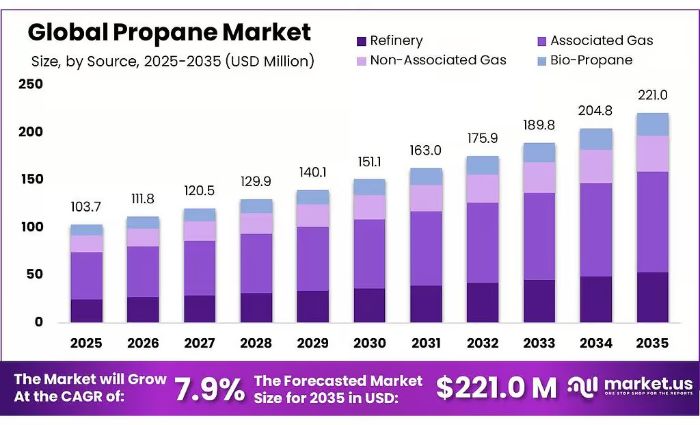
The Global Propane Market is expected to grow from USD 103.7 Billion in 2025 to nearly USD 221.0 Billion by 2035, registering a CAGR of 7.9%. Asia Pacific dominated the market with a 44.8% share, valued at around USD 46.4 Mn. Rising LPG demand, expanding petrochemical applications, and increasing propane use across residential and commercial sectors continue to support market growth worldwide.
Click to Download Free sample: https://market.us/report/propane-market/request-sample/
Key Takeaways
•The Propane Market is projected to grow from USD 103.7 Billion in 2025 to nearly USD 221.0 Billion by 2035, expanding at a CAGR of 7.9%.
•The Commercial segment led the market with a share exceeding 58.3%.
•The Associated Gas segment accounted for more than 48.2% of the total market share.
•The Residential segment maintained a leading position with over 45.5% share.
•The Bulk Delivery segment dominated the market, holding above 51.7% share.
•Asia Pacific remained the largest regional market, contributing 44.8% of total share and representing nearly USD 46.4 Mn.
By Grade Analysis
Commercial Grade Propane dominates with 58.3% market share in 2024
In 2024, the Commercial segment secured a leading market position, accounting for more than 58.3% of the total share. Its strong demand was driven by extensive usage across restaurants, hotels, food service operations, commercial heating systems, and small-scale industrial applications.
By Source Analysis
Associated Gas holds 48.2% market share in 2024
In 2024, the Associated Gas segment dominated the propane market with more than 48.2% share, supported by rising crude oil production and improved gas-processing efficiency. Increased upstream activity and flare-reduction efforts helped maintain stable propane supply.
By Distribution Channel Analysis
Bulk Delivery leads with 51.7% share in 2024
In 2024, the Bulk Delivery segment dominated the propane market with over 51.7% share, supported by strong demand from residential, commercial, agricultural, and industrial users.
Its growth was driven by large-volume storage, lower refill frequency, cost efficiency, and rising adoption of automated tank monitoring and scheduled refill systems.
Key Market Segments
By Grade
•HD-5
•HD-10
•Commercial
By Source
•Refinery
•Associated Gas
•Non-Associated Gas
•Bio-Propane
By End-user
•Residential
•Commercial
•Industrial
•Transportation
•Others
By Distribution Channel
•Bulk Delivery
•Cylinder Distribution
•Auto gas Refuelling Network
•Retail Packaged
Emerging Opportunities
Governments and multilateral organizations are increasingly supporting propane-linked cold chain projects under Sustainable Development Goal 7 (SDG7), which focuses on providing affordable, reliable, and modern energy access. The United Nations and FAO continue promoting cleaner energy alternatives that reduce dependence on biomass and diesel while improving food storage and supply systems, creating growth opportunities for propane in rural and peri-urban regions. According to the FAO, nearly 70% of the energy consumed in agrifood systems is used after harvest across transport, storage, processing, and packaging activities, increasing the importance of dependable energy sources such as propane.
Drivers
Growing Energy Demand in Food & Agriculture Boosts Propane Consumption
Rising energy demand across global food and agriculture systems is strongly driving propane consumption, particularly for heating, refrigeration, crop drying, and food processing applications. According to the FAO, agrifood systems account for nearly 30% of global energy use, while post-farm activities such as transport, storage, processing, and retail consume around 70% of total agrifood energy demand. FAO and UNEP estimates also show that nearly 526 million tonnes of food are lost annually due to weak cold-chain infrastructure and unreliable energy access, increasing the need for dependable fuel solutions such as propane.
Restraints
High Supply-Chain Vulnerability Limits Propane Availability
Supply-chain disruptions continue to restrain the propane market, as propane availability depends on crude-oil production, gas-processing facilities, and transport infrastructure that remain vulnerable to weather, geopolitical, and logistical disruptions. According to the FAO, nearly 526 million tonnes of food are lost globally each year due to unreliable energy access and insufficient refrigeration systems, while post-farm activities such as transport, storage, processing, and retail account for around 70% of total agrifood system energy consumption, increasing the impact of propane supply instability across food and agricultural operations.
Opportunity
Expanding Cold-Chain Demand Creates Growth Opportunities for Propane
Growing investment in cold-chain infrastructure is creating strong growth opportunities for the propane market, particularly in regions with unreliable electricity access and rising foodstorage needs. According to the FAO, nearly 526 million tonnes of food are lost annually due to inadequate refrigeration and cold-chain systems, while improved cold-chain infrastructure in developing countries could prevent up to 144 million tonnes of food waste each year. Supported by government initiatives and the UN’s SDG7 framework for affordable and reliable energy access, expanding cold-chain networks are also helping improve food security, rural employment, agricultural value addition, and price stability, increasing demand for dependable energy solutions such as propane.
e-mail: boltsonic20@gmail.com
web site: https://market.us/report/propane-market/free-sample/
You may also view these ads: